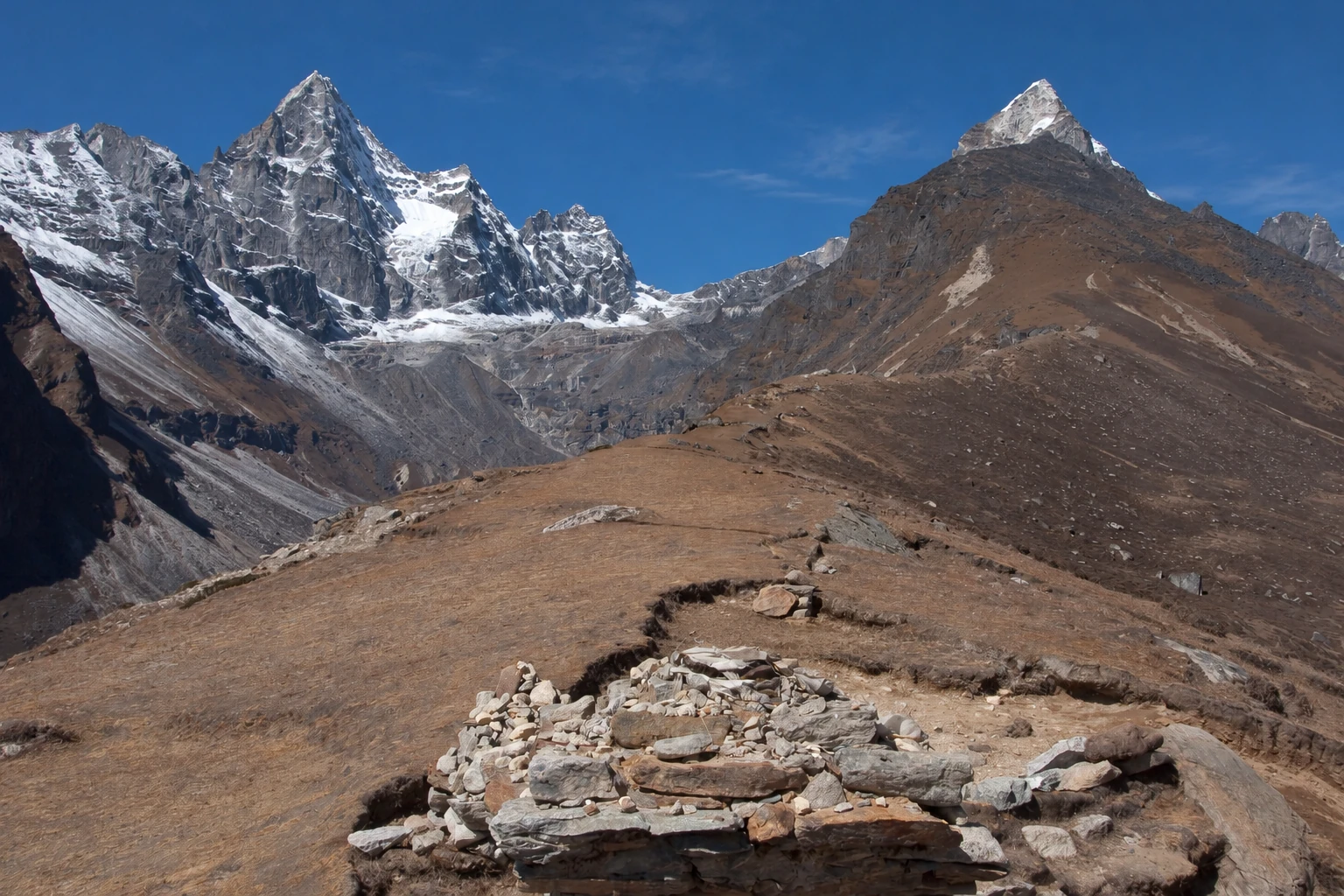
Kyajo Ri rising above the mountain landscape near Machermo in Nepal
TRN2SMMT All projects

Nepal · 2027

Kyajo Ri

Duration

17 days

Highest point

6,186 m

Departures

April–May / October–November 2027

Group

2–6 participants

The objective

A compact technical expedition into the quieter Kyajo Drangka valley, combining steep rock, snow and ice climbing with a staged ascent through two high camps to a sharp 6,186-metre summit.

Physical demand

5/5

Technical demand

4/5

Route

Southwest Ridge from Kyajo Ri Base Camp

French Alpine Grade

AD–D

Indicative only; snow, ice, rock and route conditions can materially change the climbing grade.

Suitability

Experience required

Applicants must have recent technical alpine or expedition experience and be independently competent with crampons, ice axe, fixed lines, jumaring, rappelling, rope-team travel and exposed movement in mountain boots. Previous climbing above 5,500 metres is strongly preferred. This is not an introductory trekking peak.

Preparation focus

High-altitude endurance, steep uphill capacity, upper-body and grip endurance, efficient fixed-rope systems, movement on mixed rock and ice, cold management and sound decisions under fatigue.

Included for every participant

12-week personalised Mountain Ready PRO and Sports Psychology Session.

Difficulty, fitness and preparation

What it takes to prepare for Kyajo Ri

Kyajo Ri is a technical 6,000 m expedition, not an introductory trekking peak. Climbers need recent alpine or expedition experience and independent competence on fixed ropes, steep snow or ice, exposed rock and mixed terrain.

How hard is it?

Difficulty explained

A relatively compact itinerary does not make the objective simple. The route combines altitude with consequential terrain, high camps and sustained climbing where efficiency and judgement matter as much as fitness.

Mountain environment

Altitude and acclimatisation

Kyajo Ri reaches 6,186 m and uses staged camps above base camp. The schedule must respond to individual acclimatisation, weather and route conditions; worsening altitude symptoms rule out further ascent.

Readiness markers

Fitness required

  • Expedition-level uphill endurance and recovery across consecutive days
  • Grip, pulling and trunk endurance for fixed-rope movement
  • Stable footwork in boots and crampons when fatigued
  • Capacity to carry personal equipment through technical terrain

Preparation priorities

How to train

  • Maintain a large aerobic base and develop steep ascent capacity
  • Rehearse fixed-line ascent, changeovers and controlled rappels until efficient
  • Climb rock, snow and ice in mountain boots where appropriate
  • Use specific loaded carries and long technical mountain days

Skills and terrain

Technical requirements

Applicants should already be competent with crampons, ice axe, fixed lines, jumaring, rappelling, rope-team travel and exposed movement. Exact climbing difficulty changes with snow, ice and rock conditions.

Operating window

Best season

Pre-monsoon and post-monsoon periods are commonly used. The final operating window is determined by the selected Nepal partner and current conditions.

Avoidable errors

Common preparation mistakes

  • Treating Kyajo Ri as a step up that can be learned entirely on the expedition
  • Focusing on cardiovascular fitness while fixed-rope systems remain inefficient
  • Underestimating recovery demands between high-camp carries and summit work
  • Using a published alpine grade as a guarantee of current conditions

Altitude is not a fitness test

Physical preparation improves movement, recovery and resilience, but it does not make anyone immune to altitude illness. Gradual ascent, symptom reporting and conservative guide decisions remain essential. Seek personalised medical advice from a clinician experienced in high-altitude travel where appropriate.

Route plan

Concise itinerary

Day 01

Arrive in Kathmandu

Private airport transfer, hotel check-in and team welcome at 1,350 metres.

Day 02

Preparation and briefing

Equipment inspection, permits, expedition briefing and final preparation in Kathmandu.

Day 03

Fly to Lukla; trek to Phakding

Take the scheduled Lukla flight and begin the approach to Phakding at 2,610 metres.

Day 04

Phakding to Namche Bazaar

Climb through the Dudh Koshi valley to Namche Bazaar at 3,440 metres.

Day 05

Namche acclimatisation

Hike toward Everest View at approximately 3,880 metres, then return to Namche to sleep lower.

Day 06

Namche Bazaar to Mende

Leave the main Khumbu trail and trek to Mende at approximately 3,736 metres.

Day 07

Mende to Base Camp

Enter the quieter Kyajo Drangka valley and establish Base Camp at approximately 4,550 metres.

Day 08

Acclimatisation and training

Rest, acclimatise and rehearse crampon, ice-axe, rope, ascent and descent systems at Base Camp.

Day 09

Base Camp to Camp I

Climb over moraine and glacial terrain to Camp I at approximately 5,200 metres.

Day 10

Acclimatise at Camp I

Consolidate altitude adaptation, review conditions and prepare for the higher route.

Day 11

Camp I to Camp II

Climb steeper technical terrain to Camp II at approximately 5,700 metres.

Day 12

Summit Kyajo Ri

Climb steep snow, ice and rock to the 6,186-metre summit, then descend to Base Camp.

Day 13

Weather reserve

Hold a dedicated reserve day at Base Camp for weather, route conditions or recovery.

Day 14

Base Camp to Namche

Descend from the Kyajo Drangka valley to Namche Bazaar at 3,440 metres.

Day 15

Namche Bazaar to Lukla

Complete the return trek to Lukla at 2,860 metres.

Day 16

Fly to Kathmandu

Take the scheduled return flight and transfer to the Kathmandu hotel.

Day 17

Final departure

Private transfer to Kathmandu airport for the onward journey.

Mountain itineraries remain flexible. The expedition leader may adjust the plan for weather, trail, route, acclimatisation or safety considerations.

Supplier plan clarity

Supplier plans are quoted separately and are never blended: the attached Alpinist Club itinerary specifies one climbing Sherpa per member (1:1), while the alternative Nepal Guide Treks partnership specifies one guide for every two climbers (1:2). The final private proposal will identify the selected operator, guide ratio, inclusions and contingencies before admission is confirmed.

Programme

Included

  • 12-week personalised Mountain Ready PRO preparation programme
  • Sports Psychology Session
  • Airport transfers and scheduled domestic transport in Nepal
  • Scheduled accommodation and meals during the mountain programme
  • Required local permits, route logistics and Nepal-based support team
  • Guide and porter support, including staff insurance and group medical kit
  • Three Kathmandu hotel nights with breakfast and one welcome dinner
  • Kyajo Ri climbing permit and royalty, national park and local entry fees
  • Return Kathmandu or Ramechhap–Lukla flights and required road transfers
  • Lodges on the trek; shared two-person tents at Base Camp and high camps
  • Three mountain meals daily, including tea and coffee with meals
  • Up to 25 kg of porter-carried personal baggage during the trek
  • Licensed climbing Sherpa support under the selected supplier plan
  • Shared fixed and dynamic ropes, group climbing equipment, camp crew and equipment transport
  • Staff insurance, expedition waste management, group medical kit and summit certificate when earned
  • USD 300 climbing Sherpa summit bonus under the attached itinerary supplier plan

Plan for

Not included

  • International flights and Nepal entry visa
  • Personal travel, medical and high-altitude rescue insurance
  • Personal clothing, footwear and specialist equipment
  • Meals in Kathmandu unless specifically stated in the final trip brief
  • Personal expenses, charging, showers, communications, drinks and laundry
  • Gratuities, evacuation costs and additional expenses caused by delays or itinerary changes
  • Lunch and dinner in Kathmandu except the included welcome dinner
  • Additional accommodation, meals or transport caused by early arrival, late departure, early return, flight disruption or an extended expedition
  • Technical equipment rental unless expressly included in the private quotation

Start the conversation

Plan your 2027 Nepal trip

Kyajo Ri is selected for you. You can change the trip or choose “Not sure, help me choose”.

No departure or group size is confirmed by this form. It is an enquiry, not a booking commitment.

Recommended windows only. Exact dates and availability are confirmed individually.

This is an enquiry, not a booking. Your details are sent securely to TRN2SMMT for a direct response.

Planning answers

Kyajo Ri frequently asked questions

Is Kyajo Ri suitable for a first climbing peak?

No. It is intended for climbers with recent technical alpine or expedition experience, not for someone learning foundational movement and rope systems for the first time.

What experience is expected?

Applicants should be independently competent with crampons, ice axe, fixed lines, jumaring, rappelling and exposed movement, with prior high-altitude climbing strongly preferred.

How technical is Kyajo Ri?

It involves steep rock, snow, ice and mixed terrain. The exact difficulty changes with conditions, so any grade should be treated as indicative rather than fixed.

How is suitability decided?

TRN2SMMT reviews recent climbs, altitude history, technical competence, current training and the time available to prepare before discussing admission.

Admission by application

Start with a conversation, not a checkout.

We will review your experience, current capability and preparation timeline before confirming suitability. Programme pricing is provided privately after application.